Jojoba Oil Benefits for Skin: What It Is, How It Works, and What to Look for on Labels
- Apr 17
- 6 min read

Walk through the ingredient list of almost any body oil, serum, or moisturizer and you'll find jojoba oil listed as a main ingredient. It's one of the most widely used botanical ingredients in skincare — but widespread use doesn't always mean widespread understanding.
Let's take a deep dive into understanding what this magical wonder plant is and why it's so widely used in skincare.
What Is Jojoba Oil?
Jojoba (pronounced ho-HO-ba) is extracted from the seeds of Simmondsia chinensis, a hardy shrub native to the desert regions of the southwestern United States, Baja California, and northern Mexico. Despite the species name containing "chinensis," jojoba has no connection to China — it's a quirk of early botanical classification.
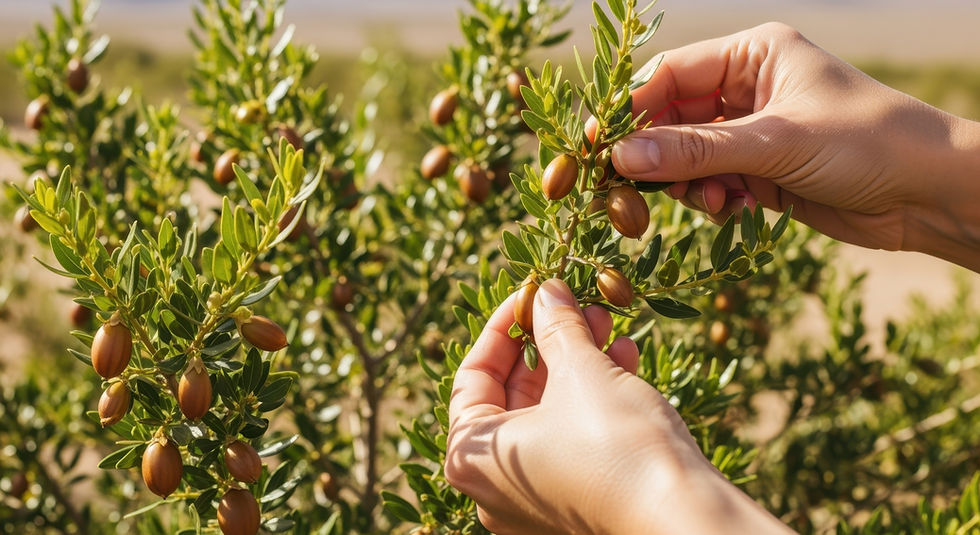
What makes jojoba genuinely unusual among plant-derived skincare ingredients is its chemistry. Technically, it isn't an oil at all. Jojoba is a liquid wax — composed primarily of long-chain wax esters rather than the triglycerides found in most plant oils. This is not a minor distinction.
Wax esters make up a significant portion of human sebum, the oil your skin naturally produces. Jojoba's molecular structure is closer to your skin's own chemistry than almost any other plant-derived ingredient. That similarity is the foundation of everything that makes jojoba valuable in skincare.
Jojoba also has an exceptionally long shelf life. Its high natural Vitamin E content gives it oxidative stability without needing added preservatives — one reason it's used so widely as a base or carrier ingredient in formulations.
A Brief History: Why Jojoba Has Been Used for Centuries
Long before jojoba appeared in modern skincare, it was used by Native American communities in the Sonoran Desert for generations. The wax was applied to treat skin conditions, soothe wounds, and care for the scalp and hair — uses that align closely with what research has since confirmed about its properties.
This matters for a reason beyond origin storytelling. Jojoba is a plant adapted to survive in one of the harshest environments on earth, and humans identified its usefulness for skin long before the beauty industry existed. .
Jojoba Oil Benefits for Skin

Supports your skin barrier
Your skin barrier — the outermost layer — is made up largely of lipids whose job is to hold moisture in and keep irritants out. When that barrier is compromised, skin loses water more easily through a process called transepidermal water loss, or TEWL. The result is dryness, sensitivity, and skin that feels chronically uncomfortable.
Jojoba's wax esters work at the surface of the skin barrier, reinforcing its lipid structure and helping it retain moisture. Understanding this distinction matters: jojoba isn't delivering hydration to your skin from the outside — it's helping your skin do its own job of keeping moisture in. If you want to understand more about how the skin barrier works and why it matters so much for skin health, this guide to skin barrier repair covers it in depth.
Mimics your skin's natural oils
Because jojoba's wax ester profile is so similar to human sebum, skin tends to receive it as familiar rather than foreign. This is part of why jojoba is so consistently well-tolerated across skin types — including sensitive, oily, and acne-prone skin. It doesn't sit heavily on the surface the way some richer plant oils can. It integrates more naturally, absorbs readily, and doesn't leave a greasy residue.
Delivers Vitamin E and antioxidant protection
Jojoba is naturally rich in Vitamin E (tocopherols), which helps protect skin cells from oxidative stress caused by daily exposure to UV light, pollution, and environmental aggressors. This isn't a single dramatic visible effect — it's a sustained layer of protection built into the ingredient itself, contributing to skin resilience over time.
Non-comedogenic
Jojoba doesn't clog pores. Its sebum-like chemistry makes it unlikely to cause the kind of surface buildup that leads to congestion or breakouts, which is why it appears regularly in formulations developed for sensitive or acne-prone skin.
How Jojoba Compares to Other Skin Oils

Most plant oils — like Brazil nut oil or squalane — are composed of triglycerides, which is the standard structure for fats and oils in nature. Jojoba is the exception: its wax ester structure gives it a profile that sits closer to skin's own chemistry than any triglyceride-based oil can.
That said, jojoba and triglyceride-based oils are not in competition — they do different things. Oils like Brazil nut and squalane deliver fatty acids, antioxidants, and lipids that replenish the deeper layers of the skin barrier. Jojoba's strength is in how it behaves at the surface: lightweight, non-greasy, and structurally compatible with sebum. In a well-formulated body oil or serum, these ingredients work together rather than duplicating each other. For a broader look at how oils and lotions differ in how they interact with skin, this comparison of body oil vs. lotion is a useful starting point.
Why Jojoba Is Considered a Sustainable Ingredient
Jojoba is one of the more environmentally resilient crops in commercial use. The plant thrives in arid conditions with very little water, grows well in degraded desert soils, and doesn't require the kind of land clearing associated with some high-demand botanicals. It's drought-resistant, long-lived, and has a relatively low environmental footprint compared to many other skincare oils.
For consumers paying attention to how ingredients are sourced — not just what they are — jojoba is one of the cleaner choices on the market.
How to Read Labels: Red Flags to Watch For
Jojoba's reputation is well-earned, but its popularity also means it appears in formulations where it's doing far less than the marketing suggests.
Jojoba listed at the very bottom of the ingredient list. Ingredients are listed by concentration, from highest to lowest. Jojoba near the end of a long list is present in trace amounts — likely not enough to meaningfully affect your skin. It may be there to support label claims rather than to deliver results.
Jojoba as the only botanical in an otherwise synthetic formula. A single plant oil surrounded by mineral oil, silicones, or dimethicone isn't a botanical skincare product. It's a synthetic formula with botanical decoration. Check what jojoba is surrounded by before drawing conclusions about the formula.
"Jojoba extract" rather than jojoba oil. The standardized INCI name for jojoba oil is Simmondsia chinensis (Jojoba) Seed Oil. Vague terms like "jojoba extract" aren't equivalent and don't carry the same skin-compatible wax ester profile.
No mention of extraction method. Cold-pressed jojoba retains more of its natural Vitamin E and antioxidants than oil extracted through heat or chemical processing. Cold-pressed is a meaningful quality signal. If a brand doesn't mention it, it's worth asking.
The Bottom Line on Jojoba Oil for Skin
Jojoba is one of the few skincare ingredients where the science, tradition, and sustainability story all hold up. Its wax ester chemistry makes it genuinely compatible with skin in a way most plant oils aren't — supporting the barrier, absorbing cleanly, and working across skin types without causing congestion. Concentration, formulation context, and extraction method determine whether it's actually doing anything in a product. When those things are right, jojoba is quietly one of the most effective ingredients in a formula — which is why it's in Savia Body Oil alongside the South American botanicals at the core of Oceite's formulations.
Jojoba appears as a supporting ingredient in Savia Body Oil by Oceite, formulated alongside maracujá, sacha inchi, Brazil nut, squalane, and other South American botanicals.
Frequently Asked Questions
What is jojoba oil made from? Jojoba oil is extracted from the seeds of the Simmondsia chinensis plant, a shrub native to the Sonoran Desert region of North America. Despite being called an oil, it is technically a liquid wax composed primarily of long-chain wax esters — not the triglycerides found in most plant oils.
What are the main jojoba oil benefits for skin? The primary benefits are skin barrier support (by reinforcing the lipid layer and reducing TEWL), a lightweight, sebum-mimicking texture that works across skin types, and natural Vitamin E content that provides antioxidant protection. It is also non-comedogenic, making it suitable for sensitive and acne-prone skin.
Is jojoba oil good for dry skin? Yes. Jojoba's wax esters reinforce the skin barrier and help reduce transepidermal water loss — the process by which skin loses moisture to the environment. For dry skin, this kind of barrier support is often more effective long-term than surface hydration alone.
Can jojoba oil clog pores? Jojoba is generally considered non-comedogenic. Its wax ester chemistry is structurally similar to human sebum, which means it integrates naturally into the skin's surface rather than sitting on top and causing congestion. It's commonly used in formulations for acne-prone and sensitive skin for this reason.
What does cold-pressed mean on a jojoba label? Cold pressing extracts oil from plant material without heat, preserving the natural antioxidants, vitamins, and fatty acids that make the ingredient effective. Heat and chemical extraction can degrade these compounds. Cold-pressed is a meaningful quality indicator worth looking for when evaluating a product.
How is jojoba different from other plant oils? Most plant oils are triglycerides. Jojoba is composed primarily of long-chain wax esters, which are structurally much closer to human sebum. This makes it unusually compatible with skin and gives it its distinctly lightweight, non-greasy texture. It also gives jojoba exceptional stability and a long shelf life.
How can I tell if a product contains a meaningful amount of jojoba? Check its position on the ingredient list. Ingredients are listed in order of concentration. Jojoba in the first half of the list is present in amounts that can make a difference. Jojoba near the bottom is likely in trace amounts.
Is jojoba oil sustainable? Jojoba is considered one of the more environmentally responsible botanical ingredients in commercial use. The plant grows in arid conditions with minimal water, improves degraded soils, and has a relatively low environmental footprint compared to many other skincare oils.



Comments